

Ash (Y2 Miss Hackleton)
🌳 Welcome to Ash Class – Year 2🌳
Teacher: Miss Hackleton
Teaching Assistants: Miss Markham (Monday-Wednesday mornings) and Miss Dickinson (Thursday and Friday morning).
👋 A Warm Welcome from Ash Class!
Welcome to Ash Class! We are a fun, friendly, and enthusiastic group of Year 2 learners who love to explore the world around us. Our classroom is a safe, supportive space where every child is encouraged to try their best, be kind, and enjoy their learning journey.
🗓 Weekly Reminders
-
PE is every Tuesday – Please ensure your child comes to school in full PE kit, including suitable footwear.
-
Spellings- Red words- are sent at the beginning of each half term along with homework. They link to the red words that your child will read in their phonics group.
-
Book bags should be brought to school daily, with planners and reading books inside.
Our school target is 4+ reads at home each week – thank you for your support! -
Label everything! – Please make sure all items of clothing, book bags, water bottles, and lunch boxes are clearly labelled with your child’s name.
Year 2 Autumn Term 2 Home Learning Menu
Class Text: The Tin Forest/The Great Fire of London
REMEMBER, THESE ARE ONLY IDEAS – CHILDREN CAN USE THEIR OWN IMAGINATION AND CREATIONS.
You may complete tasks in any order. One piece is expected each week but feel free to do all of them 😊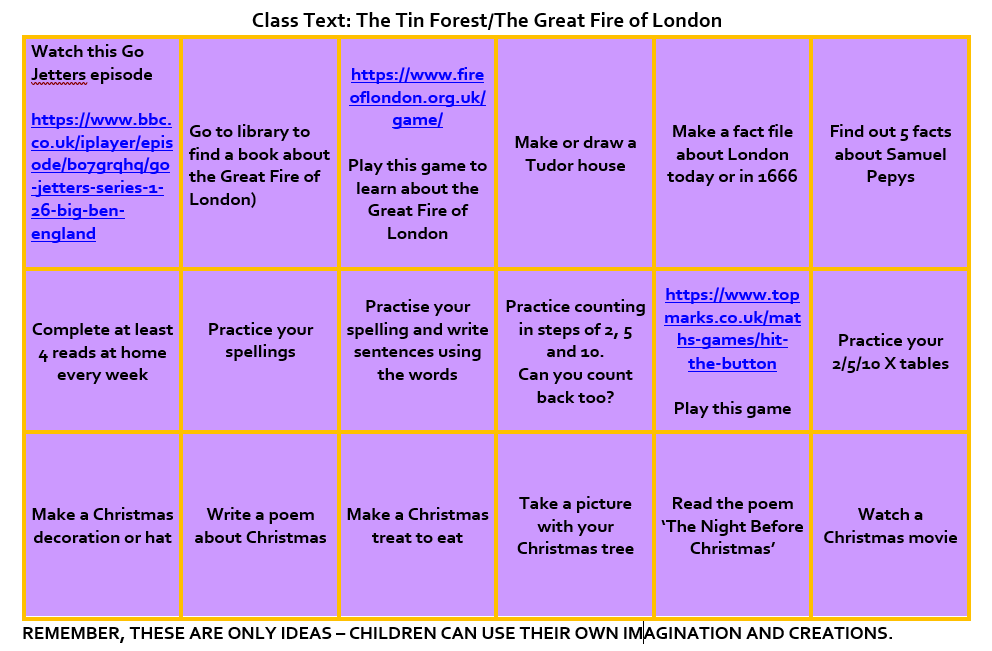
Our PE day will be Wednesday this half-term -please ensure your child brings their PE kits daily or leaves them at school for the half-term as PE days can be subject to change or for additional PE days.
Children will receive new spellings each Friday which will be stuck in their planners -spelling tests will be on a Friday.
It is expected that children will read 4 times a week, practice spellings and times tables and bring a piece of homework on a Friday -either relating to the topic or of their own interests.
English
This half-term, Year 2 will be exploring the story The Tin Forest by Helen Ward
Through reading and discussing the text, children will develop their reading, writing, speaking and listening skills. We will focus on understanding characters, making predictions, and explaining events from different points of view.
What we will be learning this half term Our focus text: The Tin Forest
This half term, Year 2 will be exploring the wonderful picture book The Tin Forest by Helen Ward and Wayne Anderson. Through this imaginative story, children will discover how a lonely old man transforms a rubbish-filled landscape into a beautiful, living forest.
We will use the story to develop our reading, writing, speaking and listening skills, while thinking about the importance of looking after our environment and never giving up on our dreams.
What will we learn?
Reading and comprehension
-
Make predictions about the story using the illustrations and title.
-
Explore new vocabulary and discuss its meaning.
-
Answer questions about the characters, setting and events.
-
Make inferences about how the old man might be feeling.
-
Retell the story in the correct sequence.
Writing
-
Write descriptive sentences about the setting.
-
Use interesting adjectives and expanded noun phrases.
-
Practise using capital letters, full stops and commas in lists.
-
Write sentences using conjunctions such as and, but and because.
-
Write our own imaginative descriptions and create an alternative ending to the story.
Speaking and listening
-
Discuss how the old man feels at different points in the story.
-
Share ideas about how the forest changes.
-
Explain our opinions and listen carefully to others.
How can you help at home?
You can support your child’s learning by trying some of these fun activities together:
1. Become a word detective!
Look at pictures of forests, plants and animals. Collect interesting words to describe them, such as lush, enormous, delicate, colourful and peaceful.
2. Describe a magical forest
Ask your child to imagine walking into a magical forest. What can they see, hear, smell and feel? Encourage them to write three descriptive sentences.
3. Retell the story
Talk about what happens at the beginning, middle and end of The Tin Forest. Can your child explain how the setting changes?
4. Help our environment
Go on a nature walk and look for ways to care for the environment. Discuss recycling, planting flowers and protecting wildlife.
5. Create a tin creature
Using recycled materials, design and make an imaginary creature that might live in the tin forest. Encourage your child to describe their creation in writing.
Questions to ask your child
-
Why do you think the old man wanted to change his surroundings?
-
How did the forest change throughout the story?
-
How do you think the old man felt at the beginning and end?
-
What does the story teach us about hope and looking after nature?
-
If you could create your own forest, what would you include?
Remember!
Reading regularly, talking about stories and practising writing sentences at home will help your child become a confident and enthusiastic reader and writer.
Maths
Addition and subtraction
What will we be learning?
In Year 2, children will develop their understanding of addition and subtraction using practical equipment, pictures, number lines and written calculations. We will encourage children to explain their thinking and choose strategies that help them solve calculations accurately.
Adding two numbers
-
Add numbers using objects and pictures.
-
Add a 1-digit number to a 2-digit number.
-
Add two 2-digit numbers.
-
Understand exchanging ten ones for one ten where appropriate.
Subtracting numbers
-
Find the difference between two numbers.
-
Subtract a 1-digit number from a 2-digit number.
-
Subtract two 2-digit numbers.
-
Use counting back and counting on to solve problems.

Number facts and problem solving
-
Recall number bonds to 10 and 20.
-
Understand how addition and subtraction are linked.
-
Use related facts to check answers.
-
Solve one-step problems involving everyday situations.
Key vocabulary
Addition (+)
Add, altogether, total, sum, more than
Subtraction (−)
Subtract, take away, difference, fewer, less than
Number facts
Number bonds, tens, ones, inverse
Checking
Calculate, estimate, explain, check
How can you help at home?
You do not need worksheets or special equipment to practise Maths. Short, enjoyable activities as part of everyday life can make a real difference.
1. Count everyday objects
Count toys, pieces of fruit or coins. Ask, “You have 12 grapes and eat 4. How many are left?”
2. Play a dice game
Roll two dice, add the numbers together and then find the difference between them. For a challenge, use two-digit numbers.
3. Practise number bonds
Ask your child questions such as “What goes with 7 to make 20?” or “20 take away 8 equals what?”
4. . Maths while shopping
Ask, “We need 15 apples for a party and have bought 9. How many more do we need?
Year 2 History – The Great Fire of London
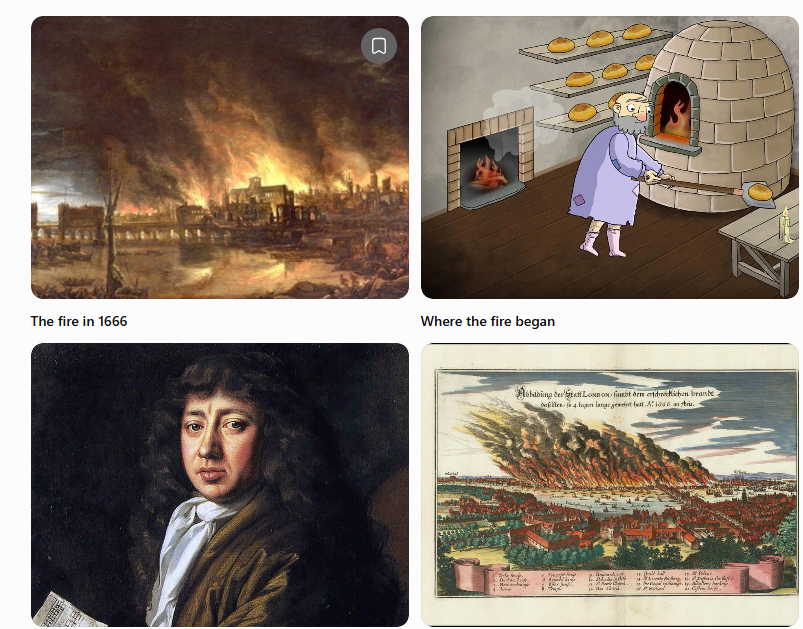
What will we be learning?
This half term, Year 2 will be travelling back in time to discover what happened during the Great Fire of London in 1666. We will explore what life was like in London over 350 years ago, investigate how the fire started and spread, and discover how the city changed after this famous historical event.
Through stories, historical pictures, artefacts and exciting classroom activities, the children will develop their understanding of the past and learn how historians find out about events that happened long ago.
What will our children learn?
🏠 Life in London in 1666
We will discover what London was like in the 17th century. Children will explore how people lived, what their homes were made from and how life was different from today.
🔥 How did the fire start and spread?
We will learn about the fire that began in a bakery on Pudding Lane on 2 September 1666. We will investigate why the fire spread so quickly, considering the closely packed wooden houses, narrow streets and dry weather.
📜 How do we know about the past?
We will look at historical paintings, maps, pictures and Samuel Pepys' diary to find out what happened. We will begin to understand how historians use different sources of evidence to learn about the past.
⏳ Understanding chronology
We will place the Great Fire of London on a timeline and sequence the main events, from the fire starting to its eventual ending on 6 September 1666.
🏙️ How did London change?
We will discover how London was rebuilt after the fire and consider how the event changed the city. We will compare London in 1666 with London today.
Key facts to remember
-
The Great Fire of London happened in 1666.
-
It began on 2 September 1666 in a bakery on Pudding Lane.
-
The fire lasted for several days and was finally brought under control on 6 September.
-
Many buildings were made of wood and stood very close together, helping the fire to spread.
-
The fire destroyed thousands of homes and many important buildings.
-
London was rebuilt, with changes to buildings and streets.
Important historical vocabulary
-
Past – a time that has already happened.
-
Chronology – putting events in the order they happened.
-
Evidence – information that helps us find out about the past.
-
Diary – a record of events and experiences written by a person.
-
Flammable – something that can catch fire easily.
-
Rebuild – to build something again after it has been damaged or destroyed.
-
Century – a period of 100 years.
How can you help at home?
Here are some simple activities you can enjoy together:
-
Explore the timeline: Can your child explain what happened in 1666 and put the main events in the correct order?
-
Look at old and new London: Compare pictures of London then and now. What has changed? What is still the same?
-
Become a history detective: Look at pictures of houses from 1666. Can your child explain why the fire spread so quickly?
-
Practise the vocabulary: Talk about words such as past, evidence, chronology and rebuild.
-
Read together: Find a child-friendly book or watch an age-appropriate programme about the Great Fire of London. Encourage your child to share three facts they have learned.
Questions to ask your child
-
When did the Great Fire of London happen?
-
Where did the fire start?
-
Why did the fire spread so quickly?
-
How do we know what happened in 1666?
-
What happened to London after the fire?
-
How is London today different from London in the past?
What will success look like?
By the end of our topic, children should be able to describe some features of London in 1666, recall key facts about the Great Fire, sequence important events and explain some reasons why the fire spread. They will also begin to use historical evidence to answer questions about the past.
Thank you for supporting your child's learning. We hope they enjoy becoming history detectives as we explore this fascinating event in British history!
at home?
You could support your child’s learning by:
-
Talking about what the words good news, hope and forgiveness mean.
-
Sharing the Easter story and discussing why it is important to Christians.
-
Asking your child how Jesus showed love and kindness to others.
-
Looking for everyday examples of people helping, forgiving and caring for one another.
-
Encouraging your child to think about how small acts of kindness can make someone’s day better.
Questions to discuss together
-
What makes something good news?
-
How did Jesus show love to other people?
-
Why is forgiveness important?
-
Why do Christians celebrate Easter?
-
How can we bring hope and happiness to others?
We look forward to an exciting half term of learning, exploring beliefs and thinking about how people can show kindness and care in our world.
Computing
This half term, we will become digital photographers! We will learn how to use a digital device to take photographs, explore how photographs can be improved and understand how images can be used to share information and ideas.
What will we learn?

1. Using a digital camera
We will learn how to use a camera or tablet to take photographs, hold the device carefully and find the camera controls.

2. Taking a good photograph
We will explore how to frame a photograph, choose what to include and think about how close or far away we should stand.
3. Exploring different viewpoints
We will take photographs from different angles and compare how changing our position can change the picture.
4. Reviewing and improving photographs
We will look carefully at our photographs, decide which ones work best and explore simple ways to improve them, such as cropping.
5. Staying safe with photographs
We will discuss why we should ask permission before photographing other people and why we must be careful when sharing images online.
Key vocabulary
Camera
A device used to take photographs.
Photograph
A picture taken using a camera or digital device.
Portrait
A photograph of a person or a picture arranged vertically.
Landscape
A photograph of scenery or a picture arranged horizontally.
Frame
The area we choose to include in our photograph.
Crop
To remove unwanted parts around the edges of a photograph.
How can you help at home?
Go on a photo hunt
Encourage your child to take photographs of three interesting things at home or outdoors, with adult supervision.
Experiment with viewpoints
Take a photograph of a favourite toy from above, below and from the side. Talk about which photograph they prefer and why.
Talk about photographs
Look at family photographs together. Discuss what makes a photograph clear, interesting or useful.
Remember online safety
Remind your child to ask permission before taking photographs of other people and to check with a trusted adult before sharing pictures.
How will we know our children are successful?
By the end of the unit, children should be able to:
-
Use a digital device to take a photograph.
-
Choose and frame a subject carefully.
-
Take photographs from different viewpoints.
-
Review photographs and explain which they prefer.
-
Make simple improvements to a photograph.
-
Explain why permission and online safety are important.
Questions to ask your child
-
What did you take a photograph of today?
-
How did you make your photograph interesting?
-
What happened when you changed your viewpoint?
-
How could you improve your photograph?
-
Why should we ask permission before taking or sharing a photograph of someone?
RSE
OS3: Online Strangers
What will we be learning?
This half term, Year 2 children will learn how to stay safe when using computers, tablets and other devices. We will explore what it means to be an online stranger and why it is important to be careful when communicating with people on the internet.
Children will learn that people online are not always who they say they are. They will discuss why they should never share personal information with people they do not know and why they must always tell a trusted adult if something online makes them feel worried, uncomfortable or unsure.
What will your child learn?
By the end of this unit, children will be able to:
-
Recognise online strangers and understand that people they meet online may not be who they claim to be.
-
Keep personal information private, including their full name, home address, school, passwords and photographs.
-
Know what to do if someone they do not know contacts them online.
-
Understand the importance of telling a trusted adult if they receive a strange message, are asked to share information or see something that worries them.
-
Make safe choices online and remember that they should never agree to meet someone they have met online.
How will we learn?
Through age-appropriate discussions, scenarios and practical activities, children will consider different situations they might encounter online. They will practise identifying safe and unsafe choices and learn simple steps to take if they feel unsure.
Our key message will be: Stop, don't reply, and tell a trusted adult.
How can you help at home?
You can support your child by:
-
Talking regularly about the games, websites and apps they use.
-
Reminding them never to chat privately with strangers online.
-
Checking age ratings and using parental controls on devices and games.
-
Encouraging them to come to you if anything online makes them feel uncomfortable, without worrying about getting into trouble.
-
Practising who they could speak to if they needed help, such as a parent, carer or teacher.
Key questions to ask your child
-
What is an online stranger?
-
What information should we keep private?
-
What should you do if someone you don't know sends you a message?
-
Who are your trusted adults?
-
What should you do if something online makes you feel worried?
Our important online safety rule
Be SMART online: keep personal information private, never arrange to meet an online stranger, and always tell a trusted adult if something doesn't feel right.
Working together, we can help children develop the confidence and knowledge they need to enjoy technology safely and responsibly.
Anti-Bullying: Choosing Kindness
What will we be learning?
This half term, Year 2 children will be learning about bullying, kindness, friendship and how to help others feel safe and happy at school. We will explore what bullying means, how our words and actions can affect other people, and what we can do if we see or experience unkind behaviour.
Children will be encouraged to understand that everyone deserves to be treated with kindness and respect, whatever their differences.
What will we learn about?
-
Being kind: Understanding how kind words and actions can help others feel happy, included and valued.
-
Friendship: Exploring what makes a good friend, including sharing, listening, taking turns and showing respect.
-
Understanding bullying: Learning that bullying is hurtful behaviour that happens repeatedly and involves someone being targeted. We will distinguish bullying from a one-off disagreement or unkind incident.
-
Recognising feelings: Thinking about how bullying and unkind behaviour can make people feel and developing empathy for others.
-
Speaking up: Knowing what to do if we experience or witness bullying, including telling a trusted adult.
-
Celebrating differences: Understanding that everyone is unique and that differences should be respected.
-
Online kindness: Beginning to understand how to communicate safely and kindly when using technology, and what to do if something online makes us feel upset or uncomfortable.
How can you help at home?
You can support your child’s learning by talking about kindness, friendship and how we treat other people.
Here are some ideas to try together:
-
Talk about kindness: Ask your child, “What kind thing have you done for someone today?”
-
Discuss friendship: Talk about what makes a good friend and how we can help others feel included.
-
Explore feelings: Encourage your child to explain how different situations might make someone feel.
-
Practise speaking up: Remind your child that it is always okay to tell a trusted adult if someone is hurting, frightening or repeatedly upsetting them.
-
Encourage inclusion: Look for opportunities to discuss how we can welcome others into games and activities.
-
Promote online safety: Remind your child never to share personal information online and to tell an adult if a message, game or online interaction makes them uncomfortable.
Questions to ask your child
-
What does it mean to be a good friend?
-
How can you help someone who feels left out?
-
What is the difference between a disagreement and bullying?
-
Who could you talk to if someone was being unkind to you?
-
What could you do if you saw someone being bullied?
-
How can we show respect for people who are different from us?
Our key message
Choose kindness, include others and speak up.
At school, we want every child to feel safe, respected and valued. By working together, we can help create a happy school where everyone belongs and bullying is never ignored.
What we will be learning
In Year 2, children will learn about personal information and how to keep themselves safe in the real world and online.
Children will learn to:
-
Understand what personal information is, including their name, address, phone number, school and photographs.
-
Recognise which information should be kept private.
-
Understand why it is important to protect personal information.
-
Know what to do if someone asks them for personal information.
-
Understand that they can say “no” if they feel uncomfortable.
-
Identify trusted adults they can talk to if they feel worried or unsure.
-
Understand how to stay safe when using the internet and digital devices.
-
Recognise when a situation does not feel right and know how to ask for help.
Why is this important?
Learning about personal information helps children to:
-
Stay safe and make sensible choices.
-
Understand what information is safe to share and with whom.
-
Develop confidence and independence.
-
Recognise situations that may make them feel uncomfortable.
-
Know that it is always OK to ask a trusted adult for help.
How we will teach this
-
Through age-appropriate discussions and stories.
-
Using role-play and practical activities.
-
Exploring real-life and online safety scenarios.
-
Encouraging children to share their thoughts and ask questions.
-
Discussing the difference between public and private information.
How you can support your child at home
-
Talk about personal information and why some details should remain private.
-
Remind your child not to share personal details online without permission.
-
Encourage your child to tell a trusted adult if something worries them.
-
Reinforce that they can say “no” if they feel uncomfortable.
-
Discuss who they can go to for help at home, at school and in the community.
-
Keep conversations about online safety open and positive.
Need more information?
If you have any questions about this topic, please speak to your child's class teacher.
Together, we can help our children stay safe, confident and informed.
Year 2 RSE – OS2: Personal Information
What we will be learning
In Year 2, children will learn about personal information and how to keep themselves safe in the real world and online.
Children will learn to:
-
Understand what personal information is, including their name, address, phone number, school and photographs.
-
Recognise which information should be kept private.
-
Understand why it is important to protect personal information.
-
Know what to do if someone asks them for personal information.
-
Understand that they can say “no” if they feel uncomfortable.
-
Identify trusted adults they can talk to if they feel worried or unsure.
-
Understand how to stay safe when using the internet and digital devices.
-
Recognise when a situation does not feel right and know how to ask for help.
Why is this important?
Learning about personal information helps children to:
-
Stay safe and make sensible choices.
-
Understand what information is safe to share and with whom.
-
Develop confidence and independence.
-
Recognise situations that may make them feel uncomfortable.
-
Know that it is always OK to ask a trusted adult for help.
How we will teach this
-
Through age-appropriate discussions and stories.
-
Using role-play and practical activities.
-
Exploring real-life and online safety scenarios.
-
Encouraging children to share their thoughts and ask questions.
-
Discussing the difference between public and private information.
How you can support your child at home
-
Talk about personal information and why some details should remain private.
-
Remind your child not to share personal details online without permission.
-
Encourage your child to tell a trusted adult if something worries them.
-
Reinforce that they can say “no” if they feel uncomfortable.
-
Discuss who they can go to for help at home, at school and in the community.
-
Keep conversations about online safety open and positive.
British Values
During this learning, children will also develop an understanding of:
- Mutual Respect – valuing everyone's ideas and feelings.
- Individual Liberty – making positive choices.
- Rule of Law – understanding why school rules are important.
- Democracy – sharing ideas and listening to others.
- Tolerance – celebrating differences and respecting everyone.
RE - What is the good news that Christians say Jesus brings?
This half term in Religious Education, Year 2 children will be exploring the Christian belief that Jesus brings good news to the world.
We will learn about who Jesus was, the stories he told, and how his teachings encourage Christians to show love, kindness, forgiveness and hope. We will also explore why Christians believe Jesus is important and how his message continues to influence the way they live today.
What will we learn?
-
Who Jesus is and why he is important to Christians.
-
Stories from the Bible about Jesus and his teachings.
-
What Christians mean when they talk about the good news Jesus brings.
-
How Jesus showed love, kindness and forgiveness.
-
How Christians try to follow Jesus’ example in their everyday lives.
Key vocabulary
-
Jesus: The person Christians believe is the Son of God.
-
Christian: Someone who follows Jesus and his teachings.
-
Good news: A message that brings hope, joy and new beginnings.
-
Forgiveness: Letting go of anger and making a fresh start.
-
Hope: Believing that things can get better.
-
Love: Caring for others and treating them with kindness.
How can you help at home?
You can support your child’s learning by:
-
Sharing a Bible story about Jesus, such as the story of Zacchaeus or Jesus welcoming the children.
-
Talking about a time when someone showed kindness or forgiveness.
-
Asking your child how they could show love and kindness to others at school or at home.
-
Discussing how helping someone who feels lonely or upset can make a difference.
-
Exploring why Christians might pray, worship or help others as a way of following Jesus.
Questions to talk about together
-
What is the best news you have ever heard?
-
How did Jesus show kindness to people?
-
Why is forgiveness important?
-
How can we show love to someone who needs help?
-
What do you think Christians mean when they say Jesus brings hope?
Our RE learning at Brookfield Primary Academy
At Brookfield Primary Academy, we encourage children to explore religious beliefs, ask thoughtful questions and develop respect for different faiths and worldviews. Through RE, children learn about the beliefs and practices of others while reflecting on their own ideas and experiences.
Together, we can help our children explore faith, develop understanding and grow in kindness, hope and respect.
PE
Year 2 PE – Dance
What will we be learning?
In Year 2, children will explore dance through movement, creativity and teamwork. They will develop their confidence, coordination and expression while learning a range of dance skills.
We will be focusing on:
-
Learning and performing simple dance sequences.
-
Using space safely and effectively.
-
Exploring different ways of travelling, such as walking, running, hopping, sliding and jumping.
-
Creating and repeating movements in time with music.
-
Using different parts of the body to express feelings and ideas.
-
Working with a partner and in small groups.
-
Showing control, balance and coordination when moving.
-
Linking movements together to create a short dance routine.
Key Skills
Throughout this unit, children will develop:
-
Performance: Learning and performing short dance routines with control and confidence.
-
Expression: Using body movements to express feelings, ideas and moods.
-
Cooperation: Working well with others and respecting different ideas.
-
Creativity: Inventing their own movements and linking them together.
-
Coordination: Developing balance, control and awareness of space.
-
Healthy Living: Improving fitness, stamina and confidence through physical activity.
How can you help at home?
You can support your child's learning by:
-
Encouraging your child to dance and move to their favourite music.
-
Practising simple movements such as hopping, skipping, turning and balancing.
-
Encouraging your child to create their own dance routine.
-
Talking about different styles of dance, such as ballet, street dance, folk dance and cultural dances.
-
Encouraging your child to copy a rhythm or make up movements to match the music.
-
Praising their effort, creativity and confidence rather than focusing on getting every movement perfect.
Useful Websites
-
Just Dance Kids: Fun dance routines and movement ideas for children – https://www.youtube.com/@JustDanceKids
-
BBC Bitesize – Dance: Videos and information about dance and movement – https://www.bbc.co.uk/bitesize
-
GoNoodle: Fun movement activities to enc
British Values
During this learning, children will also develop an understanding of:
- Mutual Respect – valuing everyone's ideas and feelings.
- Individual Liberty – making positive choices.
- Rule of Law – understanding why school rules are important.
- Democracy – sharing ideas and listening to others.
- Tolerance – celebrating differences and respecting everyone.
Art
Artist - Andy Warhol
- To learn about the work of a range of artists
- to use drawing and painting to develop and share their ideas and imagination
- to develop a wide range of art and design techniques in using colour, pattern, texture, line, shape, form and space
Our School Value
"Together we can make our school a place where everyone feels safe, respected, included and happy to learn." 🌟
.
Useful websites
•Daily 10 - https://www.topmarks.co.uk/maths-games/daily10
•Top marks clock - https://www.topmarks.co.uk/time/teaching-clock
•Spelling shed - https://www.spellingshed.com/en-gb/
•Google Earth - https://earth.google.com/web/
•Reach out reporter (science news) - https://www.twigsciencereporter.com/
We’re really looking forward to a brilliant term in Ash Class — full of fun, learning, and new adventures!