
Writing
Writing Curriculum Intent
Our writing curriculum is designed to develop every child into a confident, fluent and purposeful writer. We believe that successful writing is built upon strong foundations, beginning in the Early Years, where children develop the essential transcription, language and communication skills that underpin future success.
In EYFS, our priority is to ensure children develop secure transcription skills, including pencil grip, fine motor control, letter formation, phonics knowledge, spelling of phonetically plausible words and the ability to compose simple sentences orally before writing them. Through meaningful mark-making, oral storytelling and carefully planned opportunities for early writing, children develop the confidence and motivation to communicate through writing.
From Year 1 onwards, the Rising Stars: Reading into Writing scheme provides a coherent, evidence-informed approach that places high-quality literature at the heart of writing. Carefully selected texts inspire pupils while explicitly teaching vocabulary, grammar, sentence construction and authorial techniques. Our writing curriculum ensures that knowledge and skills are progressively sequenced so that pupils continually build upon secure foundations, becoming increasingly independent, accurate and ambitious writers.
Implementation
Our curriculum is delivered through a structured progression from EYFS to Year 6.
In EYFS, pupils develop:
- Fine and gross motor control to support handwriting.
- Secure phonological awareness and application of systematic synthetic phonics.
- Correct letter formation and beginning handwriting fluency.
- Oral language, vocabulary and storytelling through rich interactions.
- Early sentence composition through talk before writing.
- Opportunities to write for meaningful purposes across continuous provision.
From Year 1 onwards, the Rising Stars: Reading into Writing scheme supports pupils by:
- Using high-quality texts as models for effective writing.
- Explicitly teaching grammar, punctuation and vocabulary in context.
- Modelling the writing process through shared and guided writing.
- Providing opportunities for oral rehearsal before independent writing.
- Carefully scaffolding writing before gradually removing support.
- Teaching pupils to edit and improve their work using success criteria.
- Ensuring progression in knowledge, skills and genres across each year group.
The curriculum is underpinned by regular retrieval of prior learning, explicit vocabulary instruction, high expectations for presentation and handwriting, and ongoing formative assessment to identify and address misconceptions quickly.
Impact
As a result of our curriculum, pupils:
- Develop secure transcription skills from the earliest stages, enabling cognitive capacity to focus on composition.
- Write fluently, accurately and confidently across a range of purposes and audiences.
- Demonstrate increasing independence, stamina and resilience as writers.
- Apply ambitious vocabulary and grammatical knowledge effectively.
- Draw upon the language and structures encountered through high-quality reading.
- Produce writing that shows clear progression from Reception to Year 6.
- Leave primary school equipped with the knowledge, skills and confidence to communicate effectively in secondary education and beyond.
By prioritising strong foundations in EYFS, followed by a carefully sequenced curriculum supported by Rising Stars: Reading into Writing, we ensure that all pupils, regardless of starting point, have the opportunity to become successful, enthusiastic and lifelong writers
The Reading into Writing overview can be accessed at the bottom of the page.
Spelling
We believe foundations in spelling should be put in place from an early age. Within Reception and KS1 the focus is on phonics and pupils are immersed in phonics (closely linked to their early reading development) as soon as they enter school and can access a daily phonics lesson.
As pupils move through KS1 the focus changes from phonics to the acquisition of spelling rules and strategies.
Key spelling strategies and rules are taught within the classroom and pupils receive weekly spelling lists or individualised spelling lists to learn at home.
Alongside learning spelling rules and strategies years 3/4 and years 5/6 are also expected to learn the words lists as stated in the National Curriculum. This is supported through spelling games and activities in class.
Spelling is important to all pupils, and it is essential that they are given every opportunity to embed key spelling rules so that they are then able to apply them to their own writing.
Daily spelling sessions take place in all classes using the SpellingShed scheme.
Handwriting
At Brookfield Primary Academy, we want our pupils to reach high standards of presentation in their work. We believe that if a pupil is proud of the standard of presentation they have achieved; they will be more enthused and motivated to write again and again.
Fine-motor skill development and correct pencil grip are key to developing handwriting. In Foundation 1 and 2 teachers carefully plan activities designed to strengthen the children’s finger muscles in order to have better control over their pencils.
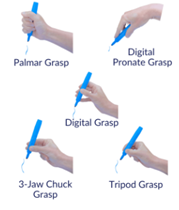
Pencil grips develop through different stages as the children develop. Children are assessed on their initial pencil grips and encouraged to work through the developmental stages towards the tripod grip in their dominant hand. In the younger year groups and where necessary, children will be monitored on their pencil grip and fine-motor skills. Where these require further support, interventions will be put in place.
Handwriting is planned and taught on a daily basis. Each class aims to have one discrete handwriting session each day. Teachers provide individual correction and support for all pupils during lessons, including letter formation, correct posture and pencil/pen grip. All pupils will start handwriting lessons with a pencil, but will move onto a handwriting pen at the teachers’ discretion. There is no age related rule for this – essentially, when the child is ready and skilled enough with a pencil, thought may be given to using a pen.
EYFS and KS1 follow the Read, Write Inc handwriting scheme, KS2 develop this further using our own Brookfield scheme of work. (IN DEVELOPMENT CURRENTLY)
Assessment
In order to assess writing throughout the academy, all teachers from FS – Year 6 will moderate 6 pieces of each child’s work across the year. If evidence isn’t specifically found in a piece of writing, teachers can assess pupils using spelling tests and handwriting in other subjects.
To ensure that judgements are secure, we work collaboratively and engage in school, trust and local authority-wide moderation sessions where writing is shared and judgements are agreed.
Special Educational Needs (SEND)
All pupils have the right to and will receive quality first teaching. Any pupils with identified SEND may have work that looks different from their peers in order to access the curriculum dependent upon their needs. As well as this, our school offers a varied curriculum, providing pupils with a range of opportunities in order for them to reach their potential and achieve highly from their starting points.
In order to engage all pupils, cultural diversity, home languages, gender, and religious beliefs are all celebrated. Our English curriculum includes a wide range of texts and other resources which represent the diversity and backgrounds of different pupils.
We recognise that parents play a large part in the education of their pupils. At Brookfield Primary Academy parents and staff work together in partnership to encourage the qualities, attitudes, knowledge, understanding, and competencies that are necessary to equip pupils for adult life.
Impact
- Pupils are taught progressively and at a pace appropriate to each individual child.
- At the end of each year, we expect the pupils will have achieved Age Related Expectations (ARE) for their year group. Some pupils will have progressed further and achieved greater depth (GD).
- Pupils who have gaps in their knowledge receive appropriate support and intervention to help them keep up.
- Books and displays will evidence high-quality writing outcomes for all pupil groups.
- Pupils will write with confidence and accuracy for a variety of purposes and audiences.
- Pupils will feel proud of their work and talk confidently about their learning.
Mrs Pounder is the Brookfield Writing lead if you would like any more information.